
Artificial intelligence has become part of many everyday digital tools. From writing and research to image creation, productivity, customer support, and business automation, AI can help people complete tasks faster and explore new ways of working.
However, with thousands of AI-powered tools now available, it can be difficult to understand what they actually do and which type of tool is suitable for a particular task. For this reason, understanding the main categories of AI tools can make it easier to find the right tool for your needs
What Are AI Tools?
AI tools are software applications or online services that use artificial intelligence to perform tasks that traditionally require human input.
Depending on the tool, AI can help generate text, analyze information, create images, summarize documents, answer questions, organize information, automate repetitive tasks, or assist with decision-making.
Because AI tools can perform such a wide range of tasks, they are generally divided into several categories. Understanding these categories can help users identify which type of tool is most suitable for a particular need.
Main Types of AI Tools
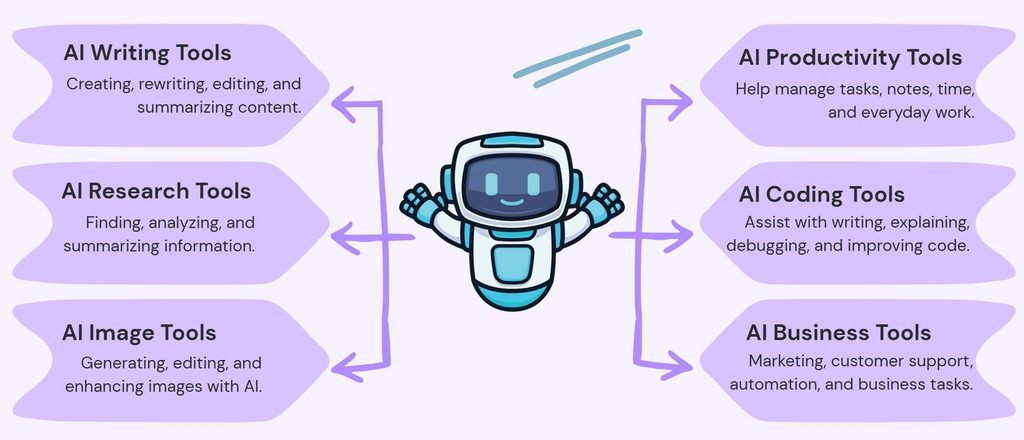
| Main Types | Common uses |
| AI Writing Tools | – Blog writing – Grammar – Summarizing – Brainstorming – Emails |
| AI Research Tools | – Research questions – Summarizing information – Finding relevant sources – Extracting key points |
| AI Image Tools | – Concept designs – Social media content – Blog illustrations – Marketing graphics – Creative projects |
| AI Productivity Tools | – Note-taking – Task management – Meeting summaries – Scheduling – Document organization |
| AI Coding Tools | – Generating code – Explaining code – Finding errors – Writing documentation |
| AI Business Tools | – Customer support – Marketing – Sales – Data analysis – Automation – Document processing |
Free vs. Paid AI Tools
Many tools offer free plans, while others require a subscription or provide additional features through paid plans.
Free versions may have limitations such as:
- Fewer features
- Usage limits
- Slower access
- Limited storage
- Restricted access to advanced models
Paid plans may provide additional capabilities, but paying for an AI tool does not automatically make it the right choice. It is useful to compare the features with your actual needs before subscribing.
Things to Consider When Choosing an AI Tool
Before using an AI tool, consider:
Purpose: What task do you need it to perform?
Features: Does it provide the functions you actually need?
Price: Is there a useful free version, or is a subscription required?
Ease of use: Can you use it without a complicated setup?
Privacy: What happens to the information you provide?
Accuracy: Can the results be checked against reliable information?
Limits: Are there restrictions on usage, file sizes, or features?
AI Tools Are Assistants, Not Perfect Answers
Although AI can be extremely useful, they are not always perfect. AI systems can sometimes produce inaccurate, incomplete, outdated, or misleading information.
Therefore, for important topics, users should verify information using trustworthy sources. In addition, reviewing AI-generated content before using or sharing it can help identify mistakes.
Ultimately, the best approach is often to use AI as an assistant rather than relying on it without review.
Final Thoughts
Overall, AI tools are becoming increasingly useful across writing, research, productivity, design, coding, business, and many other areas.
Rather than looking for one tool that does everything, it can be more useful to understand the different categories and choose tools based on the specific task you want to accomplish.
At VoltAndWise, we’ll explore different AI tools, explain what they do, compare their features, and look at how they can be used in practical situations.