AI writing tools are software that uses artificial intelligence to help you generate, edit, rewrite, or improve text. That’s the simple definition . But the practical reality is more interesting.
Think of them less like a robot that writes for you and more like a very well-read assistant who’s always available, never gets tired, and can produce a rough draft in seconds. The first draft might need a lot of work, but that remaining 40%? That’s 40% you didn’t have to write yourself.
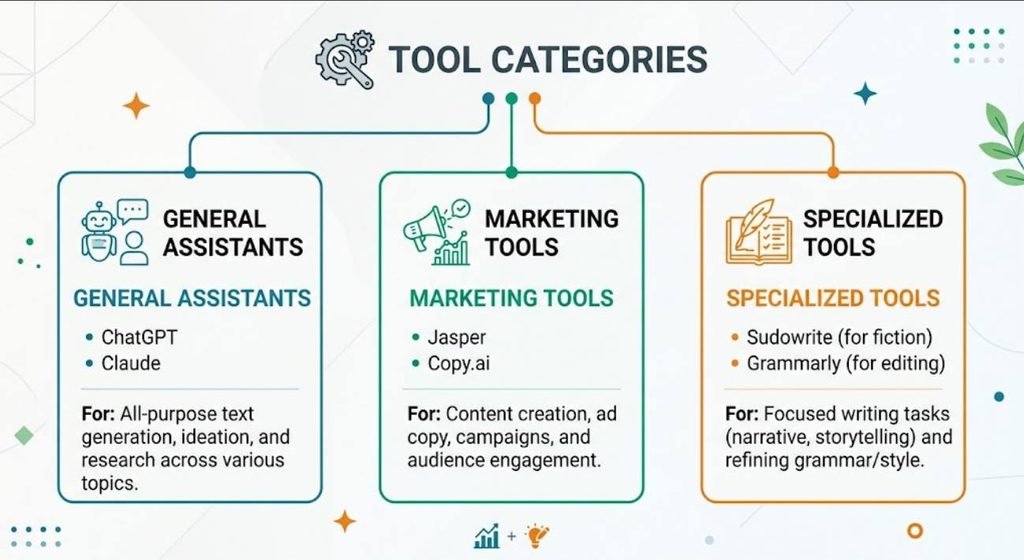
Most tools fall into a few categories: general-purpose assistants like ChatGPT and Claude that can write basically anything, marketing-focused platforms like Jasper and Copy.ai that are built for brand voice and campaigns, and specialized tools like Sudowrite for fiction or Grammarly for editing.
What These Tools Actually Do
Here’s where it gets practical. Forget the marketing fluff. What do you actually get?
Draft generation. You give a prompt, you get text. That said, quality varies wildly depending on how specific you are. A vague prompt like “write about coffee” produces vague, generic text. A prompt like “write a 200-word product description for a medium-roast Ethiopian coffee aimed at home brewers who care about origin” gets you something you can actually work with
Rewriting and paraphrasing. You paste in something you already wrote, and the tool reshapes it. Maybe you want it shorter, or more casual, or more professional. This is where tools like QuillBot shine — they’re less about generating from scratch and more about improving what exists .
Editing and grammar. This is the least glamorous but arguably most useful category. Grammarly has been doing this for years, and now almost every AI tool has some version of it. It catches the stuff you miss when you’ve read the same paragraph fifteen times
Summarization. Feed it a long document, get back the key points. Useful for research, meeting notes, or just trying to figure out if a 3,000-word article is worth your time.
SEO and optimization. Tools like Surfer SEO and Frase will analyze what’s currently ranking for your target keyword and help you structure your content to compete. They’re not magic, but they save hours of manual research
A Quick Comparison of the Major Players
| Tool | Best For | What Makes It Different | Starting Price |
|---|---|---|---|
| ChatGPT / Claude | General writing, brainstorming | Most flexible, works for almost anything | Free tiers available |
| Jasper | Marketing teams, brand voice | Brand Voice feature, campaign management | ~$49/mo |
| Copy.ai | Short-form, social media | Workflows for automating content pipelines | Free tier available |
| Grammarly | Editing, tone adjustment | Integrates everywhere, real-time suggestions | Free tier available |
| Sudowrite | Fiction, creative writing | Story Engine, sensory description tools | ~$19/mo |
| Surfer SEO | Content optimization | SEO scoring, competitor analysis | ~$79/mo |
| QuillBot | Paraphrasing, rewriting | Sentence-level control | Free tier available |
This isn’t exhaustive, and pricing changes constantly. The point is that “AI writing tool” is a broad category. A tool that’s perfect for an e-commerce brand pumping out product descriptions is useless for a novelist trying to maintain character voice over 300 pages.
The Part Nobody Tells You
Here’s the thing about AI writing tools that the marketing pages gloss over: the output quality depends heavily on the quality of your instructions and context.
I’ve seen people type “write me a blog post” and then complain that the result was generic. Of course it was. You gave it nothing to work with. The tool doesn’t know your audience, your tone, your angle, or what you’re actually trying to say. It’s filling in blanks with the most statistically likely words, and “most likely” usually means “most boring” .
The writers who get good results from these tools treat them like a collaborator, not a vending machine. Good context comes first. Say who the piece is for and what it needs to accomplish. Then specify tone, length, and what to avoid.
There’s also the hallucination problem. AI tools will confidently state things that are completely false. They’ll invent statistics, misattribute quotes, and make up sources that don’t exist. If you’re using these tools for anything that matters — academic work, journalism, business reports — you need to verify every factual claim .
And maybe most importantly: AI tends to write with a certain sameness. It loves em dashes. It overuses words like “meticulous” and “testament.” It defaults to a tone that’s slightly too formal, slightly too polished, and slightly too hollow. Readers are starting to notice, and it’s becoming a credibility issue .
How to Actually Use These Tools Well
Your own ideas should come first. AI is great at expanding on a thought. It’s terrible at having one. The framework, the argument, the angle — that should come from you. Use AI to flesh it out, not to invent it from nothing .
Be specific in your prompts. “Write a blog post” gets you mush. “Write a 500-word blog post for small business owners explaining why they should care about AI writing tools, in a conversational tone, with one concrete example” gets you something usable .
Ruthless editing is non-negotiable. Read what the tool produces out loud. If it doesn’t sound like something you’d actually say, rewrite it. If a claim feels off, check it. Your name is on the final product, not the AI’s .
Use free tiers to experiment. Most tools have free versions that are good enough to figure out whether they fit your workflow. Don’t pay for something before you know you’ll actually use it .
Consider what you’re optimizing for. Meanwhile, if you’re writing for SEO, tools like Surfer or Frase will help you structure content that ranks. If you’re writing fiction, Sudowrite is built for that. If you just need to clean up emails, Grammarly is probably enough.
Where This Is All Going
The market for these tools is growing at something like 30% year over year . They’re getting more specialized, more accurate, and more integrated into the platforms we already use. Microsoft Word has AI built in. Google Docs has AI built in. Your email client probably has AI built in.
The question isn’t whether you’ll use AI writing tools. It’s whether you’ll use them well. The people who treat them as a replacement for thinking will produce a lot of words that say nothing. The people who treat them as a tool — one that needs direction, editing, and a human brain behind it — will get more done without losing their voice.
That’s the real answer to “what are AI writing tools?” They’re a power tool. A saw doesn’t build a table. A person with a saw builds a table. Same principle applies here